Field teams often work across different customer locations, territories, and project sites, which makes it difficult for managers to verify attendance and daily field activity. When employees can check in without being physically present at the assigned location, attendance records and field reports may not accurately reflect what happened during the day.
Fake check-ins can affect more than attendance. They can lead to unreliable customer visit records, inaccurate productivity data, missed activities, and difficulty holding field employees accountable for their assigned work.
In this article, we will look at practical ways to reduce fake check-ins and improve field team accountability using location verification, geofencing, visit tracking, activity records, and clear field work policies.
How to Reduce Fake Check-ins and Improve Field Team Accountability
Reducing fake check-ins requires more than simply tracking an employee’s location. Businesses need to verify where and when field activity takes place, maintain supporting records, and give managers enough information to identify unusual activity.
Use Location-Verified Attendance
Instead of relying on an employee to simply mark attendance, use a system that records their location when they check in and check out. This creates a location based attendance record that managers can review when needed.
Location verified attendance is particularly useful for field employees who start their day directly at customer locations or assigned work sites. It gives businesses a more reliable record than attendance updates shared through calls, messages, or manual registers.
Set Up Geofencing for Approved Locations
Geofencing creates a virtual boundary around an approved work location, such as a customer site, office, project location, or service area. Businesses can use this boundary to control where employees are allowed to mark attendance or complete assigned activities.
For example, if a field employee is assigned to visit a customer at a specific location, the system can verify whether the employee is within the defined area when checking in. This makes it harder to record an attendance or visit from a different location.
Businesses can also create separate geofences for different customers or work locations. This is useful for teams that regularly work across multiple territories and need location specific accountability.
Track Field Activity Beyond the Check-in
A single check-in provides limited information about an employee’s day. Tracking movement, routes, assigned activities, and location history can give managers a broader view of how field employees are using their working hours.
Managers can review whether employees followed their planned routes, reached assigned locations, and completed their scheduled activities. This makes accountability part of the overall field activity record rather than something based on attendance alone.
Use Proof of Work for Important Field Activities
Location data can confirm that an employee reached a particular place, but it may not always confirm that the assigned work was completed. For important customer visits or field tasks, businesses can also collect supporting information.
This may include visit notes, photos, task updates, digital reports, or completion records. Combining location data with proof of work gives managers stronger evidence of what happened during a field activity.
Review Suspicious or Inconsistent Check-ins
Businesses should not assume that every unusual check-in is a fake one. Instead, managers can review patterns that may require further attention.
Repeated check-ins from unexpected locations, unusually short visits, large gaps between activities, or attendance records without corresponding field activity may indicate that a record needs to be reviewed. Looking at patterns over time is more useful than judging an employee based on a single unusual entry.
Create Clear Attendance and Field Visit Policies
Technology is more effective when employees understand how attendance and field visits should be recorded. Businesses should clearly define where employees need to check in, when they should record a visit, what counts as a completed activity, and what information needs to be submitted.
The policy should also explain how genuine exceptions are handled, such as customer cancellations, poor network coverage, or changes to the day’s schedule. Clear rules reduce confusion and give managers a consistent basis for reviewing field activity.
Combine Tracking Data With Regular Performance Reviews
Field tracking data becomes more useful when it is reviewed as part of regular performance management. Managers can compare attendance, customer visits, completed tasks, travel activity, and other relevant metrics to understand how employees are performing.
This does not mean monitoring every employee action throughout the day. The goal is to use reliable field data to identify recurring issues, provide support where needed, and maintain accountability across the team.
How FieldTrack360 Helps Improve Field Team Accountability
Field employee tracking software helps businesses bring employee location data, attendance, and daily field activity into one place. FieldTrack360 provides these capabilities through a platform designed to help managers monitor field employees and maintain clearer records of their work.
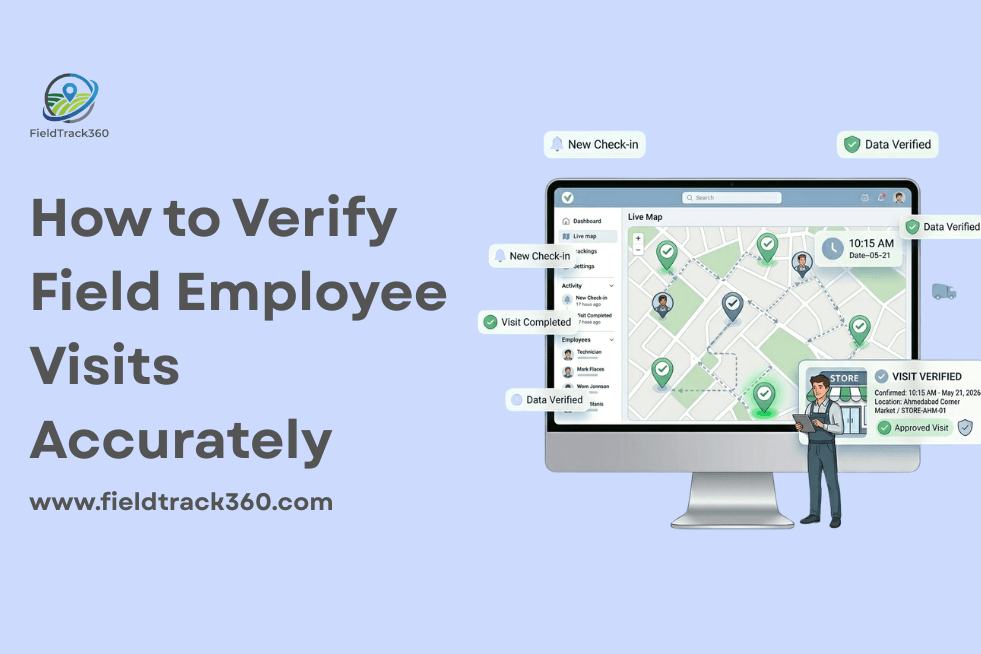
Managers can track employee locations in real time, use geofencing to define approved work areas, review route history, and monitor customer visits. Employees can also record visit details, submit notes and images, and update task progress, giving managers more information to review than attendance data alone.
FieldTrack360 also provides attendance and field activity reports that help businesses review employee movements, completed visits, and daily work records. These records can help managers identify inconsistencies, investigate unusual activity, and make more informed decisions about field team performance.
Reducing fake check-ins requires a combination of reliable tracking tools, clear attendance policies, and consistent review of field activity. By bringing location data, attendance, visits, and task records together, businesses can improve field team accountability while reducing their dependence on manual updates.
If your business needs better visibility into field employees and their daily activities, FieldTrack360 can help you manage field operations from one place.
Ready to Improve Field Team Accountability?
Verify field attendance, monitor customer visits, track daily activities, and improve workforce accountability with FieldTrack360.
Book a Free Demo