Managing field operations becomes more challenging when employees are constantly moving between different locations throughout the day. Unlike office-based teams, field employees work outside direct supervision, making it difficult for businesses to verify attendance, track visits, and monitor daily activities in real time.
Many businesses still rely on calls, messages, or manual updates to stay informed about field operations. However, as teams grow, these methods often create delays, inconsistencies, and gaps in visibility.
This is where geo-fencing becomes useful for field-based businesses.
By creating location-based virtual boundaries, geo-fencing helps businesses automate attendance verification, improve activity tracking, and gain better visibility into field operations without depending entirely on manual coordination.
In this article, we will explore how geo-fencing helps field-based businesses improve operations, strengthen accountability, and manage field activities more efficiently.
What Is Geo-Fencing?
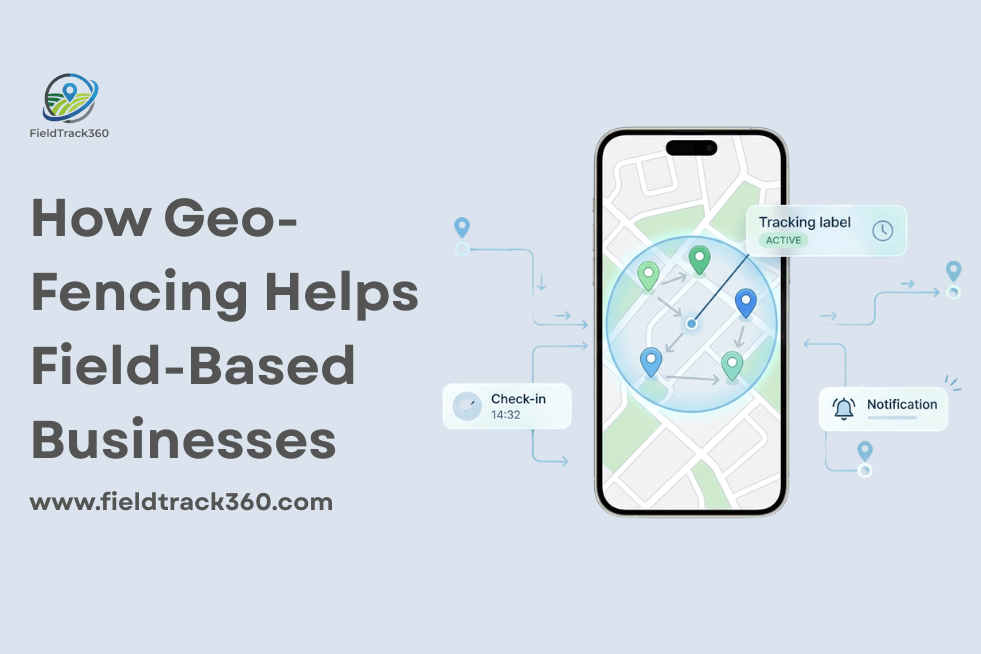
Geo-fencing is a location-based technology that creates a virtual boundary around a specific area using GPS or mobile location data. When a person enters or exits that defined area, the system can automatically trigger specific actions or updates.
In field operations, businesses commonly use geo-fencing to verify employee presence at assigned locations, automate attendance, and improve visibility into on-ground activities.
For example, a business can create a geo-fence around a client site, retail outlet, or service location. When a field employee reaches that location, the system can record the visit automatically based on the predefined boundary.
This helps businesses reduce dependency on manual verification and maintain more accurate tracking of field activities.
Why Field-Based Businesses Use Geo-Fencing
Field-based businesses often struggle with maintaining visibility and consistency across daily operations. Since employees work across multiple locations, verifying attendance, confirming visits, and tracking task completion manually can become difficult over time.
As operations grow, these challenges usually lead to delays in reporting, increased manual coordination, and limited control over field activities.
Geo-fencing helps solve many of these issues by adding location-based verification to field operations. Instead of relying only on calls or manual updates, businesses can automatically confirm whether employees have reached assigned locations and completed required visits.
This not only improves operational visibility but also helps businesses create more structured and reliable field processes.
How Geo-Fencing Helps Field-Based Businesses Improve Operations
For field-based businesses, managing daily operations becomes more difficult when there is limited visibility into employee movement and on-ground activities. Verifying attendance, confirming location visits, and tracking field tasks manually often slows down operations and increases dependency on constant follow-ups.
Geo-fencing helps solve these challenges by adding location-based automation to field operations. By creating virtual boundaries around specific locations, businesses can improve tracking accuracy, reduce manual coordination, and gain better visibility into field activities.
Below are some of the key ways geo-fencing helps field-based businesses improve operations.
Improves Attendance Accuracy
Tracking attendance manually can be difficult for field-based businesses, especially when employees work across multiple locations throughout the day. In many cases, businesses rely on calls, messages, or self-reported updates to confirm attendance.
This process can lead to inaccurate records and additional verification effort.
Geo-fencing helps improve attendance accuracy by allowing businesses to verify check-ins based on employee location. When employees enter a predefined work area, attendance can be recorded automatically within the assigned boundary.
This reduces dependency on manual confirmation and helps maintain more reliable attendance records across field operations.
Ensures Employees Reach Assigned Locations
For businesses managing field employees across multiple sites, confirming whether visits actually happened can be challenging. Manual updates and calls do not always provide complete visibility into on-ground activities.
Geo-fencing helps solve this by verifying employee presence within predefined locations. When a field employee enters the assigned area, the system can automatically record the visit based on the configured boundary.
This helps businesses maintain better control over field operations and ensures that planned visits are completed more reliably.
Reduces Manual Monitoring
Managing field operations manually often requires constant calls, follow-ups, and status checks throughout the day. As teams grow, this process becomes time-consuming and difficult to manage consistently.
Geo-fencing reduces the need for manual monitoring by automatically recording location-based activities. Instead of repeatedly verifying employee movement or visit status, businesses can rely on automated location updates within predefined areas.
This helps managers spend less time on coordination and more time on improving overall operations.
Improves Real-Time Visibility Into Field Activities
One of the biggest challenges in field operations is the lack of visibility into what is happening during the day. Managers often depend on delayed updates, making it harder to respond quickly to issues or changes in plans.
Geo-fencing helps improve real-time visibility by providing location-based activity updates as employees move through assigned areas. This allows businesses to stay informed about field movements and ongoing activities more accurately.
With better visibility, managers can make faster decisions and maintain better operational control throughout the day.
Helps Improve Accountability
In field operations, maintaining accountability can become difficult when activities are tracked manually or updates are shared inconsistently. Without clear verification, it is harder to confirm whether assigned tasks or visits were completed as expected.
Geo-fencing helps improve accountability by creating location-based records of field activities. Since visits and check-ins are linked to predefined locations, businesses gain clearer visibility into on-ground execution.
This encourages more consistent work practices and helps reduce uncertainty in daily field operations.
Supports Better Route and Territory Management
Field employees often travel across multiple locations during the day, and without proper planning, this can lead to inefficient movement and overlapping coverage areas.
Geo-fencing helps businesses better understand how field teams move across assigned territories. By analyzing location-based activity patterns, businesses can improve route planning, reduce unnecessary travel, and organize territories more effectively.
This helps optimize field operations and improves overall productivity over time.
Reduces Reporting Discrepancies
Manual reporting often creates gaps between reported activities and actual field execution. Delayed updates, incomplete information, or inconsistent reporting methods can make it difficult to maintain accurate records.
Geo-fencing helps reduce these discrepancies by adding location-based verification to field activities. Since visits and check-ins are connected to predefined locations, businesses can maintain more reliable and consistent reporting.
This improves data accuracy and helps managers make better operational decisions.
Improves Operational Efficiency at Scale
As field operations expand, managing employees manually becomes more difficult and time-consuming. Coordinating attendance, tracking visits, and verifying activities across larger teams can quickly create operational bottlenecks.
Geo-fencing helps businesses handle growing field operations more efficiently by automating location-based tracking and reducing dependency on manual coordination.
This allows businesses to maintain better control, improve consistency, and manage field activities more effectively as operations scale.
Industries That Benefit from Geo-Fencing
Geo-fencing can be useful for any business that manages employees working outside the office. By improving location-based visibility and activity verification, it helps businesses maintain better control over daily field operations.
Some of the industries that commonly benefit from geo-fencing include:
- FMCG and Retail Distribution: for tracking retail visits, attendance, and territory movement.
- Field Sales Teams: for verifying client visits and improving daily activity tracking.
- Service and Maintenance Businesses: for confirming on-site visits and managing service operations more efficiently.
- Healthcare and Pharmaceutical Companies: for monitoring medical representatives and field-based staff activities.
- Logistics and Delivery Operations: for improving route visibility and location tracking.
As field operations grow, geo-fencing helps these businesses create more structured, transparent, and efficient workflows.
Common Misconceptions About Geo-Fencing
Despite its growing use in field operations, geo-fencing is often misunderstood. Many businesses assume it is complicated, expensive, or only useful for large enterprises. In reality, geo-fencing is mainly designed to simplify operational tracking and improve visibility.
One common misconception is that geo-fencing is only about monitoring employee location. While location tracking is part of it, the bigger purpose is to automate operational processes such as attendance verification, visit confirmation, and activity tracking.
Another misconception is that geo-fencing is difficult to implement. Modern field employee tracking systems make it much easier for businesses to create and manage location-based boundaries without requiring complex technical setup.
Some businesses also believe geo-fencing is only useful for large teams. However, even smaller field operations can benefit from improved accountability, better reporting accuracy, and reduced manual coordination.
Understanding these misconceptions helps businesses see geo-fencing as a practical operational tool rather than just a tracking feature.
How FieldTrack360 Uses Geo-Fencing to Simplify Field Operations
Managing field operations becomes more effective when businesses have accurate visibility into employee activities and location-based updates. Instead of relying heavily on manual coordination, geo-fencing helps create a more structured operational process.
FieldTrack360 uses geo-fencing to help businesses improve attendance verification, monitor field visits, and maintain better visibility into daily operations. By creating predefined location boundaries, businesses can track field activities more accurately and reduce uncertainty in day-to-day execution.
This helps managers stay informed about field movements, improve accountability, and reduce dependency on constant follow-ups or manual reporting.
As field operations grow, having a centralized system supported by geo-fencing can help businesses maintain consistency and improve overall operational efficiency.
Final Thoughts
Managing field operations efficiently becomes more challenging as teams grow and daily activities spread across multiple locations. Without proper visibility and location-based verification, businesses often struggle with attendance accuracy, manual coordination, and inconsistent reporting.
Geo-fencing helps solve many of these operational challenges by adding structure and automation to field activities. From improving attendance tracking to verifying location visits and increasing accountability, it allows businesses to manage field operations with greater accuracy and control.
As field-based businesses continue to rely on mobile workforces, geo-fencing is becoming an important part of creating more efficient, transparent, and scalable operations.
Want to Improve Your Field Operations?
If you’re looking to simplify field employee tracking and improve operational visibility, you can book a free demo by contacting our team to get started.