A typical day for an FMCG sales representative does not follow a fixed script. It starts with a planned list of outlets, but the day quickly shifts based on retailer availability, stock issues, travel time, and on-ground coordination with distributors.
By the end of the day, what was planned and what actually happened are often two different things.
For managers, this creates a constant challenge. It becomes difficult to know which outlets were covered, whether targets were met, or where time was actually spent. Most updates come after the day is over, leaving little room to make adjustments when it matters.
This gap between planning and execution is one of the biggest reasons why managing FMCG field sales teams can feel unpredictable, even when targets and processes are clearly defined.
Improving efficiency in such an environment requires a more structured way of managing daily activities, tracking execution, and ensuring consistency across teams.
In this guide, we will look at how FMCG businesses can manage their field sales teams more effectively by focusing on practical systems, better visibility, and smarter execution.
What Makes FMCG Field Sales Management Different
FMCG field sales operates in a high-frequency, high-volume environment where consistency matters more than one-time performance. Unlike other sales models that focus on fewer, high-value deals, FMCG teams are responsible for covering a large number of retail outlets on a daily basis.
Each sales representative typically follows a predefined route, often referred to as a beat plan, which includes multiple stores to be visited within a limited timeframe. Along with taking orders, they are also expected to check product availability, monitor stock levels, and ensure proper product placement at each outlet.
Another layer of complexity comes from the involvement of distributors and retailers. Sales representatives often act as a link between the company and the market, coordinating orders, resolving issues, and maintaining relationships across different stakeholders.
Because of this structure, even small inefficiencies can have a noticeable impact. Missing a few outlets, spending extra time on travel, or not executing promotions properly can directly affect sales outcomes.
This makes FMCG field sales management less about individual performance and more about how consistently teams are able to execute daily activities across multiple locations.
Key Challenges in Managing FMCG Field Sales Teams
Even with clear targets and defined territories, managing FMCG field sales teams comes with a set of recurring challenges that affect day-to-day execution. Most of these issues are not always visible at first, but they directly impact sales outcomes over time.
1. Limited Visibility into Daily Activities
In many cases, managers do not have a clear view of what is happening on the ground during the day. They rely on updates shared after work hours, which makes it difficult to track progress in real time. This lack of visibility creates uncertainty around whether planned visits were completed, how time was spent, and where delays occurred.
2. Inconsistent Beat Plan Execution
Beat plans are designed to ensure proper outlet coverage, but in practice, they are not always followed consistently. Sales representatives may skip outlets due to time constraints, convenience, or changing priorities during the day. Over time, this leads to gaps in market coverage and missed sales opportunities.
3. Delayed and Incomplete Reporting
Many teams still depend on manual reporting methods such as calls, messages, or spreadsheets. These methods often result in delayed updates and incomplete information, making it difficult to get an accurate picture of daily performance.
4. Inefficient Use of Time and Travel
A significant portion of a field representative’s day is spent traveling. Without proper planning or visibility, this can lead to unnecessary movement, longer routes, and reduced time spent on actual sales activities.
5. Gaps in Retail Execution
Ensuring that products are available, properly displayed, and promoted at the retail level is a key responsibility. However, without consistent monitoring, execution can vary across locations, affecting brand visibility and sales performance.
These challenges are common across FMCG businesses, especially as teams grow and operations expand. Addressing them requires a more structured approach to planning, tracking, and managing field activities.
How to Manage FMCG Field Sales Teams Effectively
1. Build a Structured Beat Plan
In FMCG field sales, how the day is planned has a direct impact on how much is achieved. Without a clear structure, sales representatives may end up prioritizing convenience over coverage, leading to missed outlets and inconsistent market presence.
A structured beat plan helps bring consistency to daily operations. It defines which outlets need to be visited, in what sequence, and how frequently. This ensures that all assigned locations are covered systematically rather than randomly.
For example, instead of leaving route decisions to individual employees, businesses can create fixed daily or weekly plans that align with territory requirements. This not only improves coverage but also makes it easier to track whether visits are happening as planned.
When beat plans are followed consistently, teams are able to maintain better control over retail presence, reduce missed opportunities, and create a more predictable sales process.
2. Set Clear Daily Targets and KPIs
In FMCG field sales, activity alone does not guarantee results. Visiting outlets without clear objectives can lead to inconsistent performance and missed opportunities.
To improve efficiency, it is important to define what success looks like on a daily basis. This goes beyond just setting monthly sales targets. Field teams need clear, measurable expectations for each day. These can include the number of outlet visits, orders collected, sales value, or specific activities like introducing new products or checking stock levels.
When expectations are clearly defined, sales representatives can plan their day with better focus. It also becomes easier for managers to evaluate performance based on actual outcomes rather than assumptions.
For example, instead of simply tracking whether a rep was active, businesses can assess how many outlets were covered, how many orders were booked, and how effectively time was used. Clear KPIs bring direction to daily work, improve accountability, and make performance tracking more structured.
3. Track Field Activities in Real Time
One of the biggest challenges in FMCG field sales is the delay between execution and visibility. Managers often get updates only after the day is completed, which makes it difficult to respond to issues or adjust plans in real time. This gap can lead to missed opportunities, such as unvisited outlets, delayed orders, or incomplete tasks that could have been addressed during the day itself.
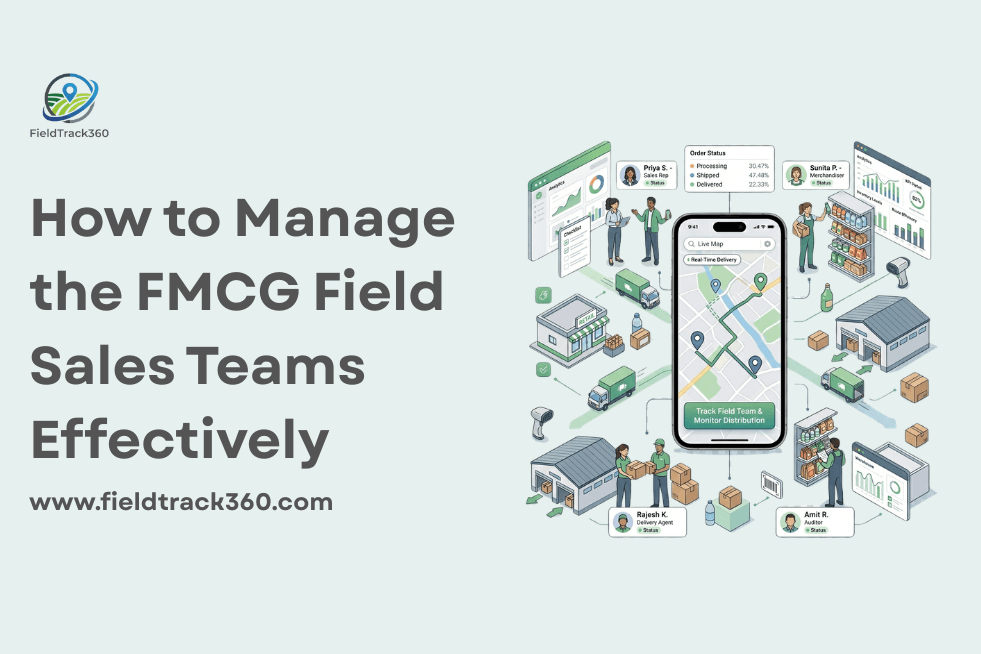
Tracking field activities in real time helps close this gap. It allows managers to see where sales representatives are, which outlets have been covered, and how tasks are progressing throughout the day.
For example, if a planned visit is skipped or delayed, it can be identified early and corrective action can be taken immediately instead of waiting until the end of the day.
Many businesses use a dedicated FMCG employee tracking software to bring this level of visibility into their operations. With a structured system in place, teams can move from reactive management to more proactive decision-making. Over time, this improves coordination, reduces uncertainty, and helps ensure that daily plans are executed more consistently.
4. Standardize Reporting Across Teams
In many FMCG organizations, reporting formats vary across teams and individuals. Some rely on messages, others use spreadsheets, and in some cases, updates are shared verbally. This lack of consistency makes it difficult to compare performance or get a clear picture of daily activities.
When reporting is not standardized, important details can be missed. Managers may spend additional time consolidating information, and decisions are often delayed because data is not available in a structured format.
Standardizing reporting helps bring uniformity to how information is captured and shared. When every sales representative follows the same format for reporting activities such as outlet visits, orders, and stock checks, it becomes easier to review performance and identify patterns.
For example, instead of collecting updates from multiple sources, managers can access all relevant information in one place with a consistent structure. This reduces confusion and ensures that decisions are based on reliable data. With a clear reporting system in place, businesses can improve accuracy, save time, and maintain better control over field operations.
5. Improve Route Planning and Travel Efficiency
A large part of a field sales representative’s day is spent traveling between outlets. If routes are not planned properly, it can lead to unnecessary movement, longer travel time, and fewer productive visits.
In many cases, routes are either loosely defined or left to individual judgment. While this may work in the short term, it often results in inconsistent coverage and reduced efficiency over time.
Improving route planning helps ensure that travel time is minimized and more time is spent on actual sales activities. By organizing outlet visits in a logical sequence based on location and priority, teams can cover more ground without increasing workload.
For example, instead of visiting outlets in a scattered order, a well-planned route allows representatives to move systematically through their assigned area, reducing back-and-forth travel. Better route planning not only improves productivity but also supports consistent execution of beat plans. Over time, this leads to more efficient use of time and better overall coverage.
6. Ensure Consistent Retail Execution
In FMCG, sales are heavily influenced by what happens at the retail outlet. Product availability, shelf placement, and in-store visibility all play a key role in driving purchase decisions.
However, maintaining consistency across multiple outlets is not easy. Different stores may have different layouts, stock levels, and priorities, which can lead to variations in how products are displayed and promoted. Without a structured way to monitor these activities, it becomes difficult to ensure that execution standards are followed across locations.
To manage this effectively, businesses need a clear process for checking in-store conditions during each visit. This can include verifying stock availability, ensuring products are placed correctly, and confirming that ongoing promotions are properly implemented.
For example, a sales representative visiting an outlet can follow a checklist to ensure that key execution points are covered. This creates consistency in how tasks are performed, regardless of location.
When retail execution is managed consistently, businesses can improve product visibility, strengthen brand presence, and create a more reliable sales process across their distribution network.
Why Manual FMCG Sales Management Fails at Scale
Manual methods can work when the team is small and operations are limited to a few locations. Managers can rely on calls, messages, or basic spreadsheets to stay updated. At this stage, coordination is relatively simple and issues can be handled quickly. However, as FMCG businesses grow, these methods start to break down.
With more sales representatives, larger territories, and increasing outlet coverage, the volume of information becomes difficult to manage manually. Updates get delayed, data becomes inconsistent, and it becomes harder to maintain visibility across teams.
For example, when multiple representatives are sharing updates through different channels, consolidating that information into a clear picture of daily performance becomes time-consuming. By the time insights are available, the opportunity to act on them may already be lost.
Manual processes also make it difficult to maintain consistency. Different team members may follow different approaches to reporting, planning, and execution, which creates gaps in performance and coordination. As a result, businesses often find themselves reacting to issues instead of proactively managing operations.
At scale, managing FMCG field sales efficiently requires a more structured system that can handle large volumes of data, provide timely insights, and support consistent execution across teams.
How FieldTrack360 Helps FMCG Businesses Manage Field Teams
As discussed earlier, many of the challenges in FMCG field sales come from a lack of structure, delayed visibility, and disconnected processes. Managing these areas manually becomes increasingly difficult as teams grow and operations expand.
This is where FieldTrack360 helps bring more clarity and consistency to day-to-day operations.
Instead of relying on multiple tools or scattered updates, businesses can use FieldTrack360 to manage field activities through a single, structured system. Sales representatives can follow predefined beat plans, update task progress, and share activity details as part of their daily workflow.
At the same time, managers get better visibility into what is happening on the ground. They can track outlet visits, monitor task execution, and review performance without waiting for end-of-day reports.
For FMCG businesses, this helps ensure that plans are executed more consistently across locations. It also reduces the effort involved in reporting and coordination, allowing teams to focus more on actual field activities.
By connecting planning, execution, and reporting, FieldTrack360 helps create a more organized and reliable way to manage FMCG field sales teams.
If you’re looking to manage your FMCG field sales teams more efficiently, you can book a demo by contacting our team to get started.