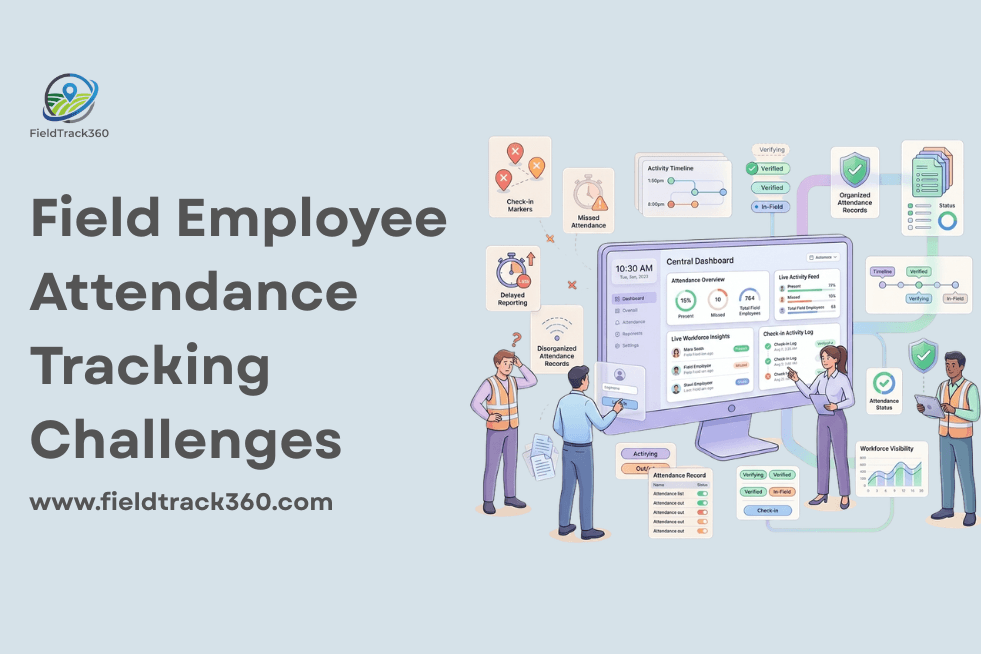
Attendance tracking plays a crucial role in managing field operations efficiently. However, unlike office-based employees, field teams work across different locations, travel frequently, and often perform tasks away from direct supervision. This makes maintaining accurate attendance records significantly more challenging.
Many businesses still rely on manual attendance registers, phone calls, spreadsheets, or end-of-day reporting to track employee attendance. While these methods may work for smaller teams, they often become difficult to manage as field operations grow. Inaccurate records, delayed check-ins, and limited visibility can make it harder for managers to understand workforce availability and maintain accountability.
Accurate attendance tracking is not only important for monitoring employee presence but also for improving operational visibility, workforce planning, and overall productivity. Businesses that establish reliable attendance processes are often better equipped to manage field teams efficiently and make informed operational decisions.
In this article, we’ll explore the common challenges businesses face when tracking field employee attendance, practical solutions to overcome them, and best practices for maintaining accurate attendance records.
Why Attendance Tracking Is Different for Field Teams
Tracking attendance in a traditional office environment is relatively straightforward, as employees typically work from a fixed location under direct supervision. Field teams, however, operate in a completely different environment. Their work often involves traveling between locations, meeting clients, visiting sites, and performing tasks across multiple territories throughout the day.
Because of this mobility, businesses often face unique challenges when trying to maintain accurate attendance records and verify employee presence. Understanding these differences is essential for building an effective attendance management process.
Employees Work Across Multiple Locations
Field employees rarely operate from a single location. Depending on their role, they may visit multiple client sites, service locations, retail outlets, or territories in a single day.
This constant movement can make it difficult for businesses to track attendance using traditional methods designed for office-based teams.
Limited Direct Supervision
Unlike office employees, field teams spend most of their working hours away from managers and supervisors. As a result, businesses often have limited visibility into when employees start work, where they are working from, and whether attendance records accurately reflect on-ground activities.
Without reliable verification processes, maintaining accurate attendance records can become increasingly challenging.
Attendance Verification Challenges
One of the biggest challenges in field operations is verifying attendance accurately. Manual check-ins, phone-based confirmations, or self-reported attendance records may not always provide sufficient visibility into an employee’s actual location at the time of attendance.
As field operations grow, businesses often need more structured methods to verify attendance and maintain consistency across distributed teams.
Common Challenges in Field Employee Attendance Tracking
Managing attendance for field employees is often more complex than tracking attendance in a traditional office environment. As teams become more mobile and operations expand across multiple locations, businesses may encounter several challenges that affect attendance accuracy, accountability, and operational visibility.
Below are some of the most common attendance tracking challenges faced by field-based businesses.
1. Inaccurate Manual Attendance Records
Many businesses still rely on spreadsheets, attendance registers, phone calls, or messaging apps to record employee attendance. These manual processes are often time-consuming and can lead to errors, missing entries, or inconsistencies in attendance records.
As the size of the field team grows, maintaining accurate records manually becomes increasingly difficult.
2. Delayed Check-Ins and Check-Outs
Field employees often begin their day from different locations, making it difficult to record attendance at a fixed time or place. In some cases, attendance updates may be submitted much later than the actual check-in or check-out time.
This can create discrepancies in attendance records and reduce visibility into workforce availability throughout the day.
3. Difficulty Verifying Employee Location
Attendance records are most effective when businesses can confirm where employees were at the time of check-in or check-out. However, traditional attendance methods often provide little or no visibility into employee location.
Without proper verification, businesses may find it difficult to maintain confidence in attendance accuracy.
4. Attendance Fraud and Buddy Punching
In some situations, attendance records may not accurately represent an employee’s actual presence. Practices such as proxy attendance or buddy punching can create inaccuracies that affect workforce management and operational reporting.
Without reliable verification methods, identifying and preventing such issues becomes challenging.
5. Lack of Real-Time Visibility
Manual attendance processes often provide limited insight into who has checked in, who is absent, or which employees are currently active in the field.
This lack of real-time visibility can make workforce planning and daily coordination more difficult for managers.
6. Managing Attendance Across Large Field Teams
As businesses expand their field operations, tracking attendance across multiple regions, territories, or teams becomes increasingly complex.
Maintaining consistency and accuracy across a larger workforce often requires structured attendance processes and better visibility into employee activity.
How Businesses Can Improve Field Employee Attendance Tracking
While attendance tracking challenges are common in field operations, businesses can significantly improve accuracy and visibility by adopting more structured attendance management processes. The goal is not only to record attendance but also to ensure that records are reliable, verifiable, and easy to manage across distributed teams.
Here are some practical ways businesses can improve field employee attendance tracking.
1. Use Location-Based Attendance Verification
Location-based attendance systems help businesses verify where employees are when they check in or check out. This adds an additional layer of validation and helps improve the accuracy of attendance records.
By linking attendance records with location data, businesses can maintain greater confidence in workforce attendance information.
2. Implement Geo-Fencing for Attendance Accuracy
Geo-fencing allows businesses to define approved attendance zones around offices, client locations, service sites, or other designated work areas.
When employees check in from these predefined locations, businesses can verify attendance more effectively and reduce the chances of inaccurate attendance entries.
3. Automate Attendance Records
Manual attendance tracking often increases administrative workload and creates opportunities for human error. Automating attendance records helps businesses maintain more consistent and accurate attendance data.
Automated systems also make it easier to access historical attendance records and generate reports when needed.
4. Track Attendance in Real Time
Real-time attendance visibility enables managers to see workforce availability as attendance events occur. This helps businesses respond more quickly to staffing requirements and maintain better operational coordination throughout the day.
Having immediate access to attendance information can also improve workforce planning and resource allocation.
5. Standardize Attendance Policies
Clear attendance policies help establish consistency across field teams. Employees should understand when attendance needs to be recorded, which locations qualify for attendance verification, and what procedures should be followed during daily operations.
Standardized processes help reduce confusion and improve attendance compliance across the organization.
How FieldTrack360 Helps Businesses Manage Field Attendance
Managing attendance across distributed field teams requires more than just recording check-ins and check-outs. Businesses need accurate attendance records, location-based verification, and real-time visibility to ensure attendance data remains reliable and easy to manage.
FieldTrack360 helps businesses simplify attendance management by combining GPS-based attendance tracking, geo-fencing, real-time visibility, and centralized reporting into a single platform.
With location-based attendance verification, businesses can confirm attendance records more accurately and maintain greater confidence in workforce data. Geo-fencing capabilities help ensure attendance is recorded from approved work locations, while real-time attendance visibility allows managers to stay informed about workforce availability throughout the day.
As part of a comprehensive field employee tracking software solution, FieldTrack360 also helps businesses improve operational visibility, strengthen accountability, and reduce the administrative effort associated with managing field teams.
By providing accurate attendance insights and centralized workforce information, businesses can make better operational decisions and manage field operations more efficiently.
Final Thoughts
Accurate attendance tracking is a fundamental part of managing field operations effectively. However, tracking attendance for employees who work across multiple locations presents unique challenges that traditional attendance methods often struggle to address.
Issues such as inaccurate records, delayed check-ins, attendance verification difficulties, and limited workforce visibility can affect both operational efficiency and workforce accountability. As field teams grow, these challenges can become increasingly difficult to manage through manual processes alone.
By adopting structured attendance management practices, leveraging location-based verification, and maintaining real-time visibility into workforce availability, businesses can improve attendance accuracy and create more reliable operational processes.
Ultimately, effective attendance tracking helps businesses strengthen accountability, improve workforce planning, reduce administrative effort, and gain better visibility into day-to-day field operations.
Looking to Improve Field Employee Attendance Tracking?
If your business is facing challenges with attendance management, workforce visibility, or attendance verification, contact our team and explore how FieldTrack360 can help streamline field operations and improve attendance accuracy.